Jun 10,2026
Why Montessori Education Prepares Children for a Future with AI and STEM
As artificial intelligence and technology continue to reshape the world around us, many parents are asking an important question: What kind of education will truly prepare our children for the future?
While technical skills will always matter, experts increasingly agree that the future workplace will value something even more important: human skills. Creativity, adaptability, critical thinking, collaboration, emotional intelligence, and problem-solving are becoming essential in a world where AI can already retrieve information, automate tasks, and generate content within seconds.
Here’s where the magic of the Montessori classroom, which is intentionally designed to help children become independent thinkers, confident problem-solvers, and curious lifelong learners, stands out.
In Montessori classrooms, children are guided to make choices, solve problems independently, and take ownership of their learning. As AI becomes increasingly capable of providing answers instantly, the ability to think critically, ask meaningful questions, and evaluate information becomes more valuable. Montessori students learn from an early age to analyze, explore, and discover rather than rely solely on external instruction.
STEM learning thrives on experimentation, observation, and problem-solving and Montessori classrooms naturally support these skills through hands-on materials and real-world exploration. Children work with concrete mathematical concepts, scientific classification, sequencing, measurement, spatial reasoning, and logical thinking long before abstract concepts are introduced. This deep conceptual understanding helps children build confidence and flexibility in learning STEM-related subjects later on.
Montessori students are encouraged to try, make mistakes, adjust, and try again. This process develops resilience, persistence, and innovative thinking, qualities required in engineering, coding, scientific research, and emerging technologies. Rather than focusing on getting the “right answer” immediately, Montessori education values the learning process itself. Children learn how to approach challenges thoughtfully and creatively, skills that technology alone cannot replace.
One of the hallmarks of Montessori education is the uninterrupted work cycle, where children engage deeply with purposeful activities for extended periods of time. Children develop strong executive functioning skills which are connected to long-term academic and professional success and are increasingly important in a world full of constant digital distractions.
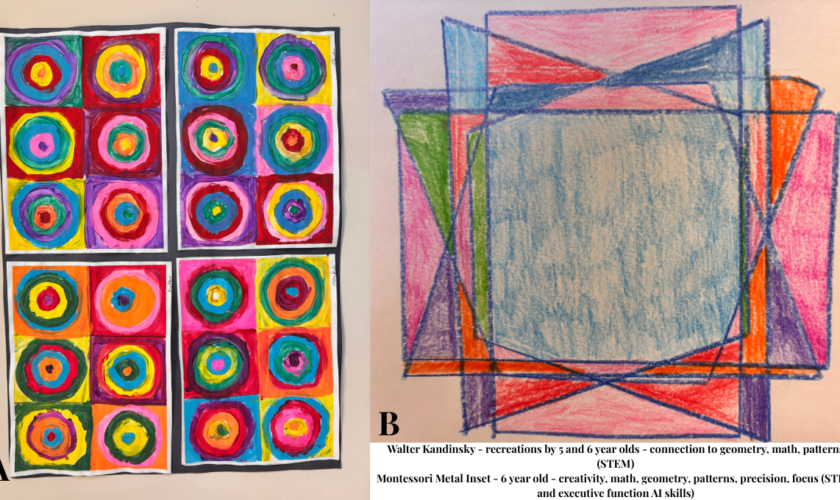
AI can generate information quickly, but creativity, imagination, empathy, and original thinking remain uniquely human strengths. Montessori classrooms foster creativity through open-ended exploration, artistic expression, storytelling, hands-on discovery, and opportunities for children to pursue their interests independently.
Engineers, scientists, designers, and developers work collaboratively to solve complex problems. Montessori’s multi-age classrooms naturally encourage teamwork, leadership, mentorship, and communication. Younger children learn from older peers, while older students strengthen their understanding by guiding others. This collaborative environment helps children build strong interpersonal skills alongside academic growth.
Technology is evolving faster than ever! Montessori education emphasizes curiosity, adaptability, and intrinsic motivation, students learn how to learn. They become comfortable exploring new ideas, asking questions, and adjusting to unfamiliar challenges, qualities that are essential in a rapidly changing world.
Preparing Children for the Future
Montessori education is not about shielding children from technology. It provides the strong human foundation children need to use technology thoughtfully, creatively, and responsibly.
In a future increasingly shaped by AI and STEM innovation, the children who thrive will be the ones who can think independently, collaborate effectively, solve problems creatively, and continue learning throughout their lives. These are the qualities Montessori education has been nurturing all along.